HEF Focus · 6 November 2026
Conte, Formigli and Big Tech: the HEF Social Dividend is not a tax
Formigli raises Trump's threat of tariffs. HEF had already presented Conte with the Systemic Social Dividend project as a compulsory mutual guarantee. The proposal will be presented to all political parties.
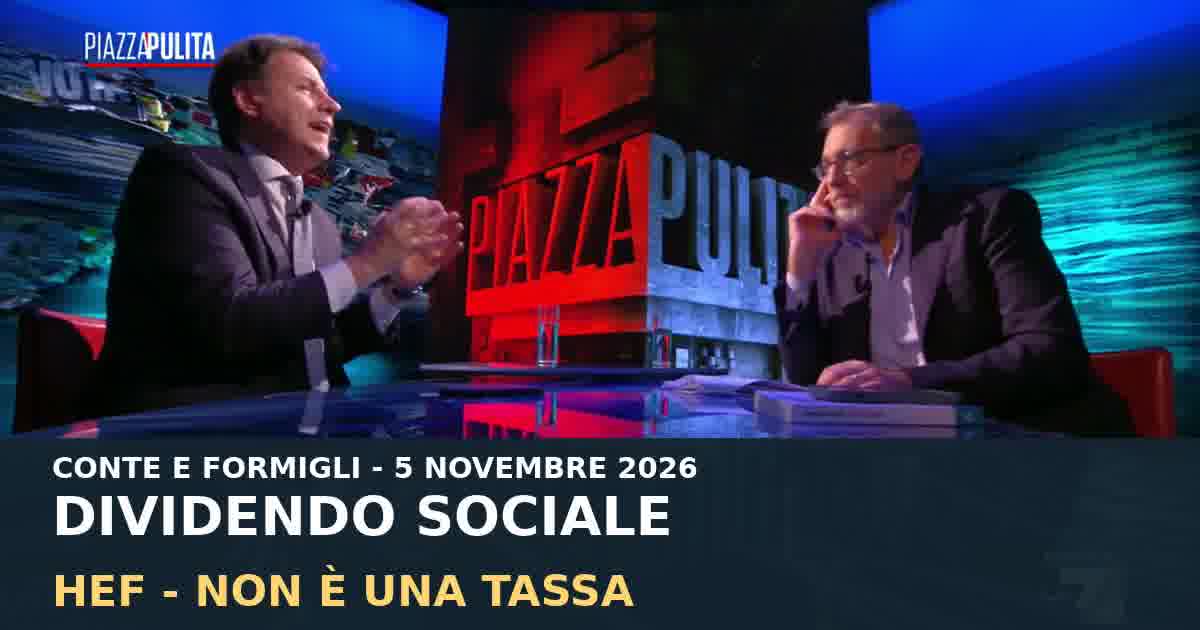
Formigli’s question: what about Trump’s tariffs?
Conte did not answer this question. Unless, when he speaks of a 'social dividend', he has in mind the 'proletarian expropriation of shares' associated with Yanis Varoufakis, it seems highly likely that he drew inspiration from the Systemic Social Dividend developed by HEF. This is more than a chance resemblance of terminology. HEF had presented the project to Conte on 29 July 2026, setting out a specific mechanism: a mandatory mutual guarantee funded in advance by systemic operators. This is precisely what remained unanswered on the broadcast: HEF's Systemic Social Dividend is not a tax. It is collective preventive insurance against the risks that major technological transformations can shift onto people, jobs and local communities.
In the HEF proposal, systemic operators would pay an advance premium linked to the risks their activities create. The money would enter an independent, ring-fenced mutual fund, with public supervision, to protect work, people and communities. It would not become revenue freely available for general public spending. An operator that verifiably reduces risk should pay less.
The principle is simple: insuring risk in advance through premiums calibrated to exposure is different from taxing income or wealth. HEF extends that logic to the risks that artificial intelligence, platforms and strategic infrastructures may transfer to people, workers and communities. The proposal requires an enabling law, but its purpose is already defined: fund protection and restoration, not general taxation.
HEF’s answer to Formigli’s question is direct: HEF’s Systemic Social Dividend does not tax Big Tech. It asks systemic operators, regardless of nationality, to finance a shared guarantee in proportion to the risks they introduce. The money funds prevention, service continuity, workforce transition and restoration—not tax revenues. Confusing a risk-based mutual premium with a tax on profits obscures the proposal before it can even be debated.
The social dividend enters public debate
On 5 November 2026, during Piazzapulita, Giuseppe Conte shifted the debate over wealth taxes towards a more structural issue: the role of major technology companies that accumulate data, control essential platforms and exercise extraordinary economic and informational power. The former Italian prime minister called for international regulation of Big Tech and floated an upstream social dividend benefiting the public, rather than relying solely on an occasional wealth levy.
A social return from the wealth generated by digital infrastructure has been discussed before. What makes the question urgent is the combination of artificial intelligence, automation and dependence on large platforms. The private benefits of technological transformation cannot be assessed separately from the risks borne by workers, families and communities. Yet a compelling phrase is no substitute for institutional design: who pays, on what basis, for which risks, and to whom?
29 July 2026: HEF had already presented its proposal
HEF presented its proposal to Giuseppe Conte on 29 July 2026, with the intention of bringing it into the coalition’s policy debate. HEF will submit it to all political parties: the protection of work, communities and the future of people is a question for every political force.
On 29 July 2026, at the Chamber of Deputies’ Sala del Refettorio in Palazzo San Macuto, the Human Economic Forum convened a discussion of the Systemic Social Dividend. The event presented works by Giammario Battaglia and Vincenzo Naschi. Giuseppe Conte attended and took part in the concluding discussion.
The issue is not to punish innovation
Large technology companies should not be deemed culpable merely because they are large or profitable. The issue arises when a firm controls data, compute, AI models, networks or platforms on which millions of people and businesses depend. That position can create systemic risks beyond the capacity of individual users, workers or local authorities to manage. Concentrated cognitive power can weaken competition; rapid automation can disrupt employment; reliance on privately controlled infrastructure can compromise essential services.
These outcomes are neither inevitable nor equally likely. Independent assessments, proportionate obligations and incentives to mitigate risks are therefore crucial. The aim is not to obstruct artificial intelligence, but to prevent the burdens of transition from being automatically socialised while its rewards remain concentrated.
What the Systemic Social Dividend actually proposes
HEF’s institutional proposal frames the Systemic Social Dividend (SSD) as a mandatory mutualistic insurance-like regime. Systemically important economic operators would finance an autonomous and legally earmarked guarantee fund in advance. Their contributions would be calibrated to the social, employment, territorial, environmental and infrastructure risks that their activities may introduce. Resources would exist before damage became irreversible, rather than only after a crisis.
The premium would not be identical for all firms or calculated as an automatic percentage of profits. A credible methodology would examine the probability and severity of possible harm, the number of people exposed, technological dependence, local concentration, employment impacts, mitigation measures and an operator’s ability to respond. Verified risk reduction should translate into lower contributions. Independent governance, public oversight and transparent reporting are prerequisites, not afterthoughts.
A collective insurance policy for the conditions of our lives
The conceptual precedent is the mutual protection already familiar in banking: certain systemically relevant activities entail collective safeguards financed by participating operators. This does not mean that deposit guarantee rules can simply be copied into AI regulation. Rather, the principle of advance, risk-adjusted financing offers a framework for designing a new social guarantee.
If a company introduces automation capable of rapidly replacing specific kinds of work, the system should already have resources for training, retraining, new employment opportunities and local productive renewal. If a region loses economic capacity or essential services, its recovery should extend beyond cash compensation. Paying the premium would never extinguish a company’s direct legal liabilities or authorise damaging conduct.
Not a wealth tax. Not a universal basic income
The legal distinction matters. A wealth tax is charged on a taxable measure of assets; a windfall tax typically refers to unusual financial gains; a universal basic income entails generalised payments. HEF’s SSD is instead a collective guarantee tied to systemic risk and to the need to prevent, mitigate or repair its consequences.
The model neither expropriates shares in large corporations nor turns citizens into compulsory shareholders in digital platforms. It is not universal basic income, a wealth tax or a windfall-profits tax. The distinction is structural: systemic risk triggers the duty, exposure determines the premium, resources enter an independent ring-fenced fund for prevention and restoration, and outcomes are independently scrutinised. That is the architecture HEF proposes to establish.
A republic founded on work, not permanent compensation
Article 1 of the Italian Constitution identifies labour as a foundation of the democratic republic. Work is more than income: it supports independence, participation and an opportunity to contribute to collective life. Articles 2, 3, 4 and 41 reinforce the duties of solidarity, substantive equality, the right to work and the social and environmental limits of private enterprise.
Where automation makes some tasks redundant, policy should not settle for managing a permanent stream of compensation. It should help create new forms of useful work, rebuild local opportunity and prevent weaker bargaining power from undermining dignity. The criticism of “handouts” concerns an approach reduced to transfers alone; it does not question the need for immediate financial protection when people need it.
Capitalism of Meaning: turning productivity into human possibility
The SSD sits within the broader Capitalism of Meaning framework advanced by the Human Economic Forum. Technological progress should be measured not only by output and lower costs, but by the possibilities it creates for people. Productivity gains can support fresh demand for care, education, health, culture, local services and relationships: activities in which human presence retains distinctive importance.
This is not an anti-business or anti-market agenda. It calls for responsibility proportionate to the power exercised and the risks generated. Those who create value must be free to innovate and compete; those who generate systemic risks must arrange the safeguards that prevent innovation from eroding the social foundations on which it depends.
HEF's proposal for all political parties
Discussions about a common programme for Italy’s broad centre-left alliance provide an opportunity to examine a mechanism beyond one-off asset taxation and after-the-fact redistribution. HEF had already tabled an institutional proposal on 29 July. It can be assessed, challenged and improved by any political group or public institution without compromising the Forum’s independence.
Hybrid threats, digital infrastructure and the price of collective security
The bomb threats reported across European aviation networks on 3, 5 and 6 November 2026 show that a message can disrupt essential services even when no explosive device is found. Flights were diverted, security operations launched and Irish newsrooms evacuated after threats received by email. According to the reports available on 6 November, the alerts examined were false, yet the costs of precautionary action and the anxiety experienced by passengers and workers were real.
These incidents should not be described as AI-generated terrorism or as proof of a failure by the platforms that carried the messages. Neither an AI role nor a specific compromise of digital infrastructures has been established. The origin and possible coordination of the threats remained under investigation. Nevertheless, they expose a wider vulnerability: essential transport and civic infrastructure depend on digital communications, identity systems, data networks and the ability to distinguish credible warnings from malicious manipulation.
The same structural problem would become even more serious if malicious actors used AI systems to amplify disinformation, impersonate authorities, coordinate digital attacks or disrupt critical infrastructure. That is a prospective risk scenario, not an assertion about the November incidents. In such a scenario, the collective consequences could include evacuation, service interruption, emergency expenditure, loss of production and—if physical attacks occurred—injury and damage.
The Systemic Social Dividend should therefore be examined as a source of advance, risk-adjusted mutual protection against certain technological and infrastructure risks, including malicious third-party uses where an operator's services create or magnify systemic exposure. The contribution would finance independently audited prevention, continuity, emergency capacity and defined forms of recovery or compensation. It must be assessed proportionately, taking account of the operator's control, foreseeable risks, effective safeguards and residual exposure. It would not turn a digital provider into the automatic guarantor of every terrorist act, nor release perpetrators or negligent operators from their own liabilities.
EU law already addresses cybersecurity risk management and the resilience of critical entities, including through the NIS2 and CER directives. The proposed mutual guarantee would need to complement, rather than duplicate or weaken, those obligations. This is the key policy shift: security is not only a public expense after a crisis, but part of the cost of operating systems on which the public has become structurally dependent.
From remarks to legislation: what is required
Turning this idea into law would require objective eligibility tests for regulated operators; robust measures of residual risk; proportionate and auditable contributions; a segregated fund with independent management and public oversight; defined benefits and access conditions; outcome measurement and conflict-of-interest safeguards; and compatibility with EU law, competition, trade obligations and existing liability regimes.
The core claim is straightforward: innovation is welcome, but society should not be expected to underwrite the risks of systemic technological transformation for free, with the lives and opportunities of its people. The question is not only how much dividend should be distributed. It is what responsibility should be provided for before harm occurs.
Documents and sources
HEF institutional proposal on the Systemic Social Dividend (PDF, Italian)