These are not identical stories. Yet both pose a question: how free are we when our income, our work and even the way we make decisions depend on powers we do not control?
Gracis and a broken promise
Italian journalist Matteo Gracis has released a video titled «The great scam: working to remain poor». His public introduction questions a generational promise: study, work hard, make sacrifices and a dignified life will follow. This is not a criticism of work itself, but of a social bargain that increasingly fails to deliver freedom.
His challenge deserves to be embraced, celebrated and widely discussed — but not merely as an invitation to anger. When paid work no longer reliably leads to emancipation, we must examine who captures the value created and how reciprocity might be restored.
This editorial draws on the video title and Gracis’s public description; it neither attributes HEF’s proposals to him nor claims to be a verbatim account of the entire recording.
Watch Matteo Gracis’s original video
Video embedded from YouTube; HEF Focus does not claim authorship. If the player is unavailable, open it on YouTube.
12–13 November 2026: when an infrastructure stops, so does part of the world
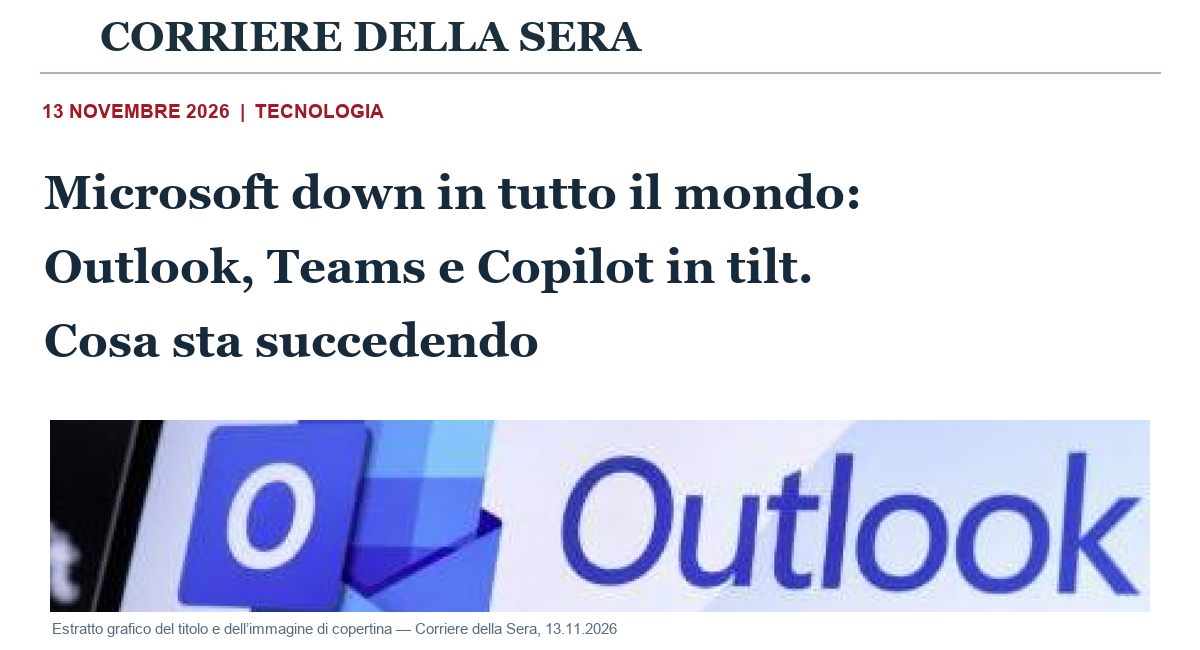
On 12 November 2026, widespread disruption affected Microsoft services including Outlook, Teams, Copilot and other Microsoft 365 products. At the peak, Downdetector recorded almost 130,000 reports about Outlook; businesses and public organisations in several regions were affected. Recovery efforts continued on 13 November.
Microsoft pointed to unavailable servers and traffic-management imbalances, with no initial indication of malicious cyber activity. We do not present these preliminary assessments as a final technical explanation or evidence of intentional conduct.
The broader vulnerability is clear: when mail, documents, meetings, procedures and AI assistants depend on a small number of integrated ecosystems, one failure can disrupt many forms of human activity. Technology is not the enemy. Resilience, reversibility and meaningful choice are public-interest concerns.
Two dependencies, one question: who can still choose?
The economic dependency Gracis describes and the digital dependency exposed by the outage are distinct. The latter does not prove the former. They intersect at a crucial point: freedom diminishes when individuals and organisations have no credible alternatives.
Interoperability, business-continuity planning, realistic switching options, broadly distributed expertise and accountable governance are indispensable. So is a capability that no software licence can provide: distinguishing information from recommendations, opportunity from conditioning and convenience from surrendering judgment.
SENSO: critical thinking must be practised
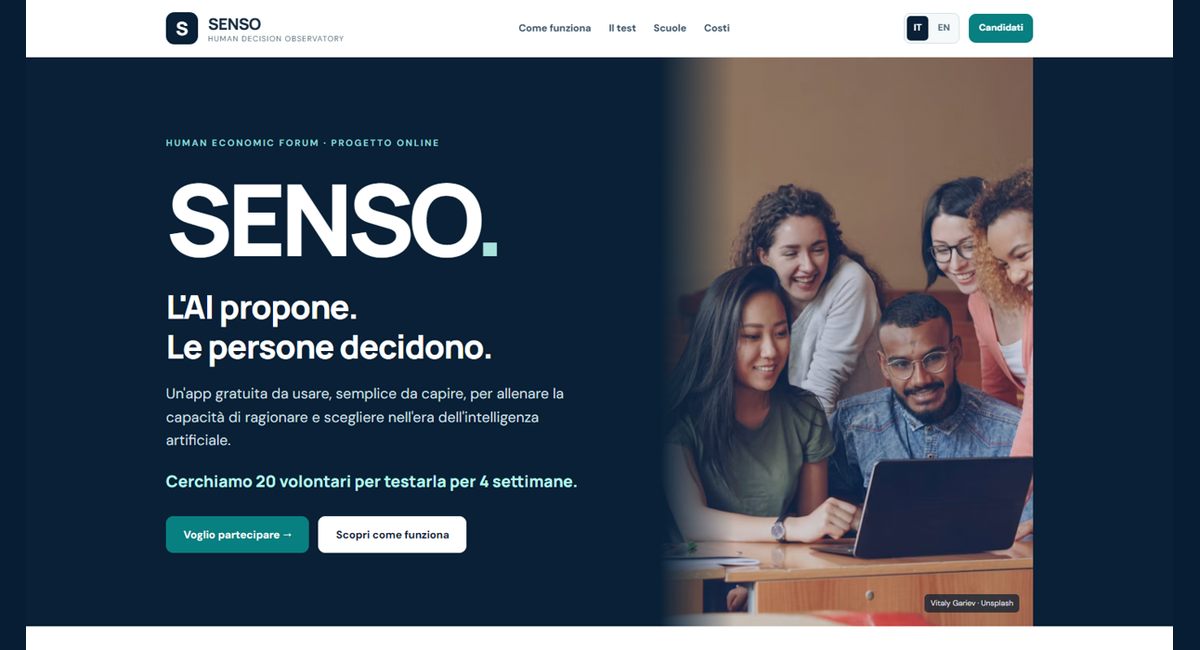
Human Economic Forum has developed SENSO — What Would You Do?, a free digital pilot in which AI offers a possible response to a real dilemma and then the participant must explain what they would do and why. Five current-affairs themes, no personal rankings: the aim is not to reward agreement with AI, but to explore independent reasoning.
The AI suggestion appears before the participant’s response, precisely so researchers can examine its possible influence. Other participants’ views become visible only after the first answer; later revisions do not erase the original. Similarity between answers alone will not be treated as proof of causation.
The first proposed pilot involves 20 adult volunteers over four weeks, with two short activities each week. A separate SENSO School edition is envisaged with teachers and universities, age-appropriate dilemmas and safeguards for minors. Critical thinking is not a supplementary skill; it is democratic infrastructure.
From San Marino to every state: a replicable proposal, not an existing institution
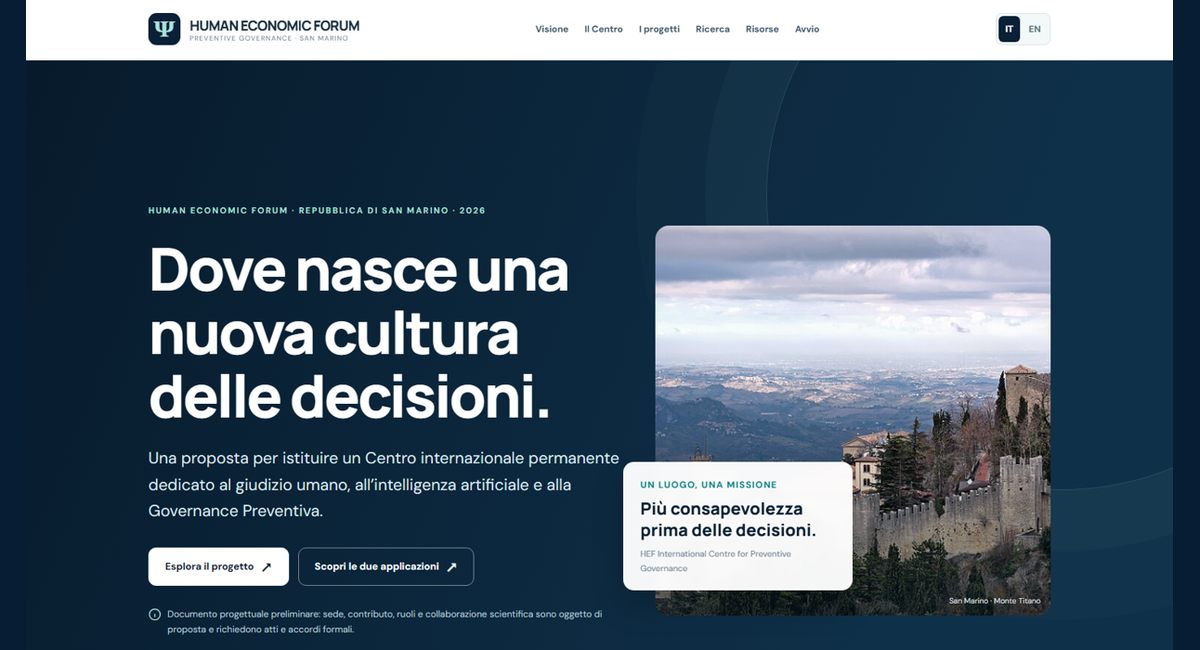
HEF has presented the Republic of San Marino with a preliminary proposal for an International Centre for Preventive Governance. Its design combines a permanent Observatory researching human judgment and AI influence with a Laboratory testing methods to improve decisions before their consequences become difficult to reverse.
It would use two applications already developed within the HEF ecosystem: SENSO and Governance Lab AI — Architect of Meaning. The proposal outlines an initial three-year horizon, an indicative start-up budget of €10,000 per year, possible institutional support and potential scientific collaboration with the University of the Republic of San Marino. No premises, university partnership, agreement or public funding is presented here as approved.
Subject to agreements, the suggested 2027 roadmap includes governance arrangements, research protocols, pilots and an annual international report. The plan separates funding, project leadership and independent scientific validation, protecting personal data and pre-existing intellectual property.
This model should not be confined to San Marino. Other countries could adapt it to their laws and institutions. We do not need centres that decide for citizens; we need institutions that help people understand what they are about to decide.
Governance Lab AI: compliance is not the same as purpose
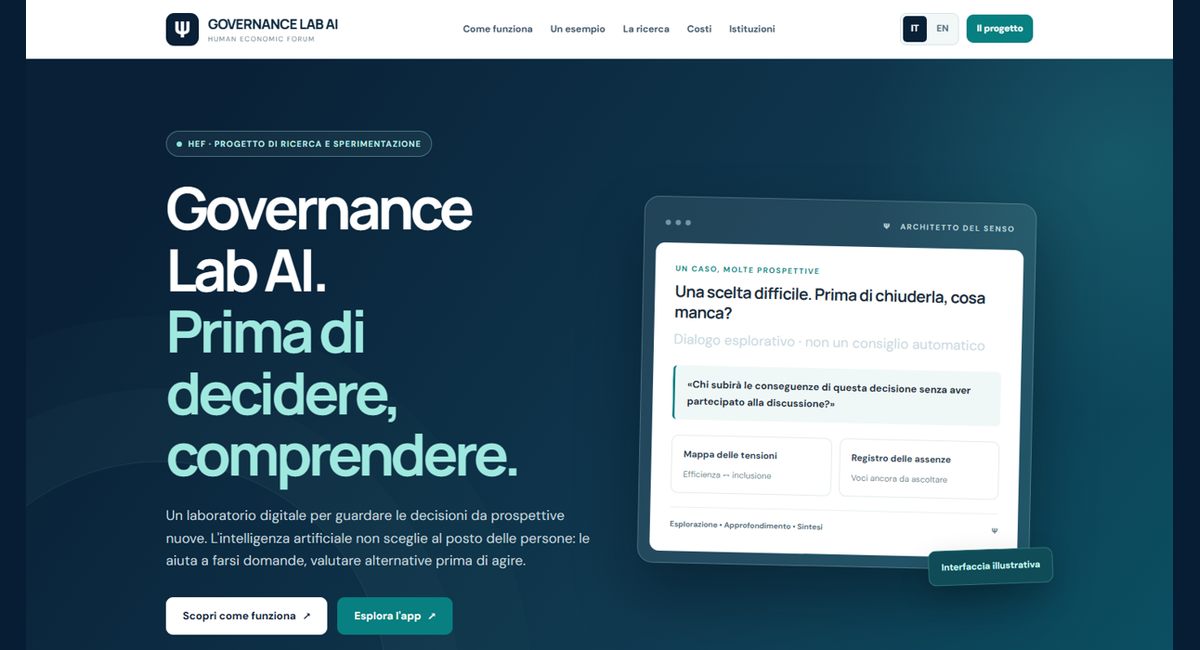
The second instrument, Governance Lab AI — Architect of Meaning, addresses businesses, professionals, associations and public authorities. Before a decision, it encourages better questions: who benefits, who bears the costs, which alternatives were excluded and which consequences have gone unheard?
The process can produce a Record of Absence, identifying overlooked issues, stakeholders and alternatives. This is not a certification, professional legal advice or a transfer of responsibility from people to AI.
Rules remain essential. But procedural compliance alone cannot answer whether a decision is meaningful, proportionate or socially sustainable. A formally correct process may still create dependency, loss of trust or neglected costs. Preventive governance asks difficult questions before procedures become a cage.
The Systemic Social Dividend: a lifeboat for capitalism
On 9 December 2026, at Italy’s Chamber of Deputies, Human Economic Forum will urge governments to engage with an institutional mechanism such as the Systemic Social Dividend (SSD). The aim is not to abolish markets, but to prevent their slide into a techno-feudal order in which a few actors command infrastructures and rents while billions lose bargaining power over their future.
The SSD is not a disguised citizenship income, an unconditional universal income detached from value creation, a general wealth tax, a share expropriation programme or simply another tax. It is a proposed architecture of systemic responsibility and reciprocity, requiring clear legal foundations, measurable risks and outcomes, independent checks and transparent social uses.
Its cultural inspiration is mutualism. European cooperative banking offers one example of economic activity organised through participation and shared responsibility. This is an institutional analogy, not a claim that the SSD is identical to a mutual bank or that its financing is settled.
The legal classification of any mandatory contributions, their proportionality and financing rules would have to be specified by lawmakers; a policy label cannot bypass constitutional obligations. The proposal should be judged by its ability to expand opportunity and support transitions, education, care and participation — without replacing fair wages, collective bargaining or welfare.
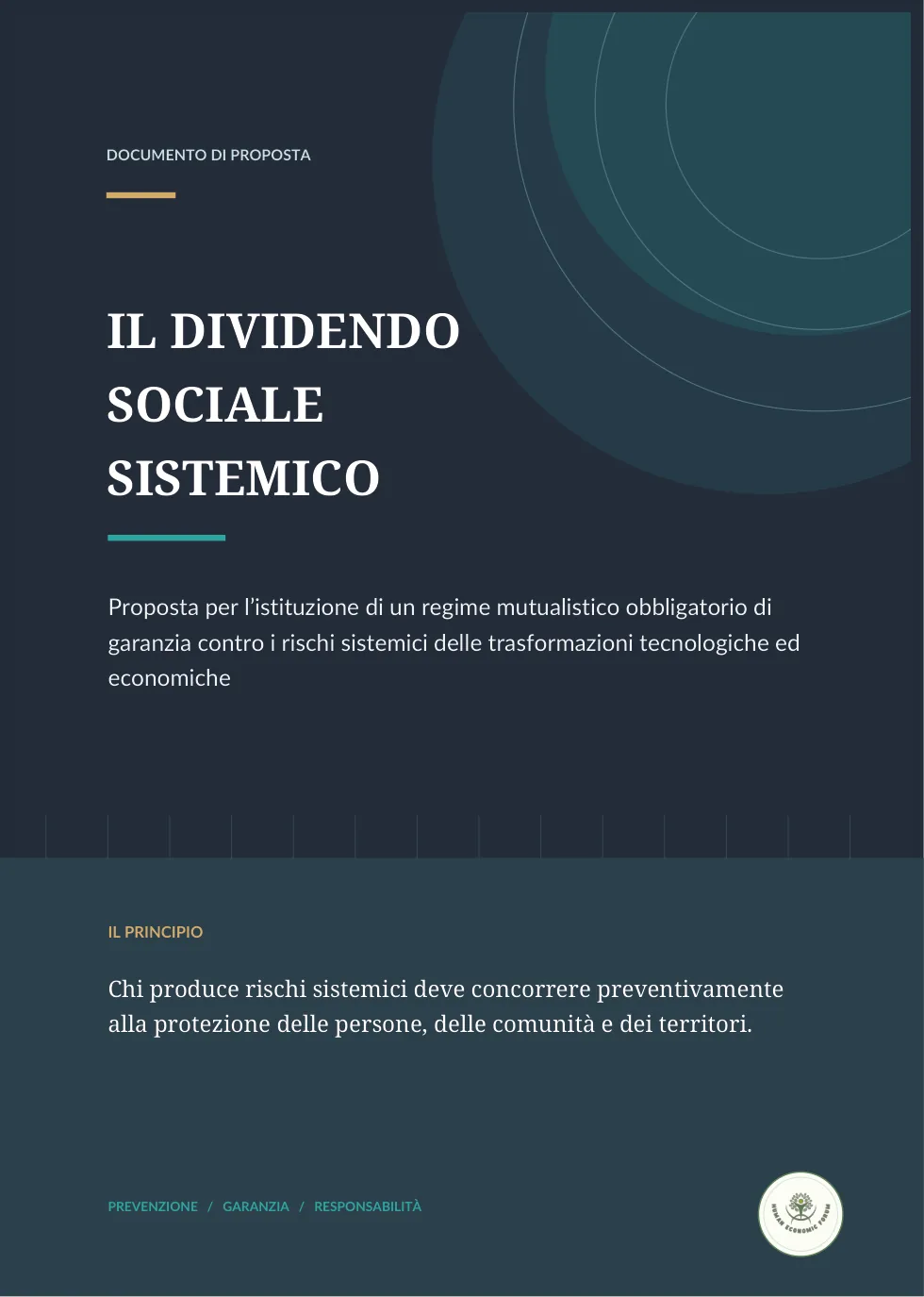
Browse the original 16-page policy document
The complete Italian-language proposal for a compulsory mutual guarantee regime covering technological and economic systemic risks.
Work should allow us to become who we can be
We want a Europe where work is more than the price paid for a service necessary to survive. It should be an expression of talent, creativity, intelligence, care and human relationships: a genuine opportunity to become the best version of ourselves.
If AI frees up time and increases productivity, that time need not become exclusion. It can support new demand for education, healthcare, care work, culture and deeply human activity. Achieving that requires institutions able to distribute opportunities as well as profits.
Work as an expression of talent also includes the ability to write, think and contribute to conversations of public significance. Together with Marco Minghetti and the Pop Opinionist community, we have championed the value of independent voices, civic dialogue and constructive participation. The LinkedIn badge reflects this recognition: freedom to work also means the freedom to contribute one's ideas, not merely to perform a task.

Gracis’s voice and the duty of those who write books
Books, research and institutional proposals can help raise policymakers’ awareness. But we also need independent journalists and communicators willing to say that apparently normal social arrangements may become forms of subordination. Today’s chains are not always visible: they can be contracts without alternatives, irreplaceable platforms or recommendations that nobody dares to question.
That is why Matteo Gracis’s reflection deserves attention and discussion. We are not asking him to endorse the SSD. We are inviting an independent conversation about a problem and the solutions we might test.
The future must not belong to a master. Freedom is not just the ability to work or use a technology: it is the power to think, choose and participate in the wealth that society helps to create.
Human Economic Forum · 9.12.2026 · Roma
Join the third Human Economic Forum
On 9 December 2026, HEF will convene in the Sala della Regina, Palazzo Montecitorio, Rome, to discuss AI, robotics, dignity, responsibility and the Systemic Social Dividend. Open the official HEF 2026 app to read the updated programme and discover the speakers before requesting accreditation. Registration requires confirmation by the organisers.
Read the full HEF San Marino Centre proposal · Explore SENSO · Read the SSD publications
Sources and transparency
- Matteo Gracis — original video
- Matteo Gracis — public announcement
- Associated Press — Microsoft outage, 13 November 2026
- Deutsche Welle — Microsoft outage, 13 November 2026
- HEF International Centre — San Marino proposal
- SENSO — project presentation
- Human Economic Forum — mission and publications
The analysis and proposals are those of HEF Focus and do not imply endorsement by Matteo Gracis, Microsoft or the institutions named. Outage details reflect reports available on 13 November 2026. The cover is an editorial illustration, not a photo of the incident.