
Who makes us dependent holds the power
Technological neo-feudalism and the answer offered by the Systemic Social Dividend
Giammario Battaglia · HEF Focus · 15 November 2026
The election campaign for 2027 has effectively begun in political language. We hear proposals to increase spending on healthcare, schools, public safety and businesses. These are real needs. Yet the crucial question often goes unanswered: where will the resources come from, and what economic model can sustain them without passing new costs to future generations?
Listing desirable spending programmes is not enough. We must explain how to fund them, choose priorities, and prevent the economic risks we are willing to tolerate. Italy is not facing only constrained public finances. Along with the rest of the world, it is experiencing a transformation of capitalism. Political debate still often uses twentieth-century categories while power is changing shape.
Today the defining question is not merely who owns wealth. It is who controls the infrastructures on which our ability to live, work, communicate and decide increasingly depends.
Money matters. But power also means taking away credible alternatives
For years, political debate has equated power with wealth: those who own more can influence more. Often this remains true. It would be naive to set money and technology in absolute opposition, because financial capital frequently funds dominant infrastructure. But wealth alone no longer explains contemporary power.
Think about electricity and water, communications networks, airline reservation systems, hospital information systems, banking services and the cloud used by public administrations and companies. When an essential function depends on a handful of providers, real freedom shrinks. We may remain customers, users and citizens in name, yet replacing a provider may require prohibitive expense or the interruption of our own activities.
A person, company or state is less free when it lacks credible alternatives. That is a political measure of systemic dependence.
No conspiracy is required. Market concentration, high switching costs, incompatible systems, the loss of internal expertise and contracts that make migration difficult are sufficient. Power also consists in the ability, intentional or not, to impose harm that others cannot prevent alone.
Matteo Gracis: work and freedom
Matteo Gracis's video invites reflection on work, income and economic freedom. The DSS addresses a complementary question: how to rebalance power arising from systemic dependence.
YouTubeWhen a server stops, far more than a server stops
On 20 October 2025, a major Amazon Web Services disruption originating in the US-EAST-1 region affected applications and services around the world. We need not attribute malicious intentions to the provider to recognise the structural problem: a single point of failure can become a collective vulnerability.
The social cost of an outage is not limited to the provider's lost revenue. Patients, students, travellers, employees, small businesses and public authorities may be harmed despite never having selected the platform themselves. Some losses can be quantified; others, such as time, access to essential care and continuity of a vital service, cannot easily be made whole.
This is why responsibility must begin before the disruption. It belongs in infrastructure design, concentration decisions, redundancy planning and the identification of risks that may otherwise be shifted silently onto the wider community.
Income support, wealth taxes and systemic dependence
Wealth taxes and income support can address redistribution and poverty, but cannot alone make critical infrastructure replaceable or prevent the erosion of bargaining power. Italy's current measures are Assegno di Inclusione (ADI) and Supporto per la Formazione e il Lavoro (SFL). ADI also includes social and employment inclusion pathways.
INPS recorded 690,000 ADI households in June 2026, an average monthly benefit of €672, and 84,304 SFL beneficiaries in payment. These are monthly figures.
The DSS addresses a different question: ex-ante responsibility for systemic dependence and residual risk. It remains a policy proposal, not enacted law, and requires validated indicators and proportional obligations.
A social dividend must specify who contributes, why, how much, and under whose oversight. Primo Di Nicola's commentary on Giuseppe Conte in Il Fatto Quotidiano (15 September 2026) raises the implementation question; it does not establish that competing proposals are absent.
A wealth tax cannot, by itself, answer the right question
Wealth taxes recur in public debate. Their merits and shortcomings deserve serious consideration. Depending on their design, they can raise revenue and redistribute resources. Yet redistribution and technological resilience are different problems.
Taxing a wealthy person does not, by itself, make an irreplaceable platform replaceable. It does not create a backup system for a hospital, rebuild the expertise outsourced to a vendor or ensure that the social cost of collapse falls on those whose activities contribute to its likelihood.
The new question I put to the political left and right alike is this: what preventive economic responsibility should be borne by those who profit from operating infrastructure on which millions can no longer avoid relying?
This is not about punishing innovation. It is about making risk transparent, measurable and financially accountable, so that profits do not remain private while the costs of crises are automatically socialised.
DSS and Varoufakis: compare the proposals
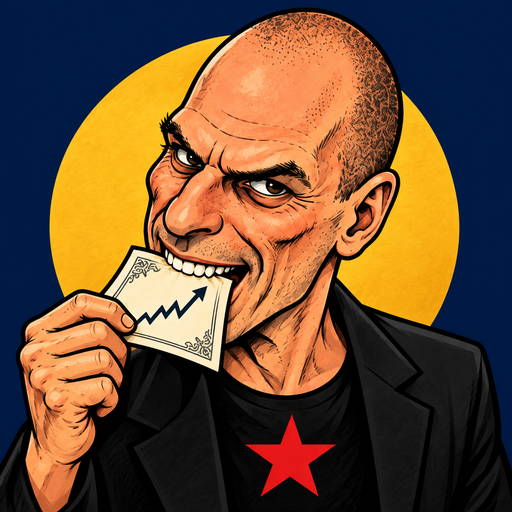
An interactive, satirical comparison of Yanis Varoufakis's Universal Basic Dividend and the Systemic Social Dividend. Their underlying economic and legal principles deserve careful examination.
Play the gameThe Systemic Social Dividend: addressing risk at its source
The Systemic Social Dividend (SSD, or DSS in Italian) is my proposal for rebalancing these relationships within the wider framework of Meaningful Capitalism — Capitalismo del Senso.
It is not a disguised basic income, a hidden wealth tax or an expropriation of technology firms. It begins with a specific observation: some economic activities create value while also producing systemic dependence and residual risks borne by society.
To turn that insight into a workable policy, the system must be measurable, proportionate and consistent with existing law. I envisage a periodic assessment of dependence using observable indicators: the essential nature of a service, provider concentration, switching difficulty, the population exposed, time needed for recovery and the severity of potential disruption.
On that basis, proportionate risk-related contributions could finance preventive resilience, service continuity and collective protection. The conceptual comparison is to mandatory insurance and financial-system safeguards: do not wait for an irreparable loss before asking who must bear the cost.
First measure the risk; then finance its mitigation and the capacity to respond. Ordinary civil liability, compensation and the handling of unlawful conduct would remain distinct legal matters to be coordinated without duplicating obligations.
The DSS is not an enacted tax, funded programme or institution already in operation. It is a proposal for scientific, economic, legal and democratic testing. Thresholds, competent authorities, calculation methods, safeguards, allocation of resources and effects on competition all need to be defined. A related account of the collective value used by large platforms deserves separate examination. The governing principle is simple: those exercising systemic power should bear proportionate systemic responsibility.
Europe has begun to act. Now connect the rules
The European Union has not been idle. DORA addresses digital operational resilience in finance and oversight of critical ICT third parties. NIS2 concerns cybersecurity among essential and important entities. The Digital Markets Act addresses the gatekeeper power of major platforms. The Data Act introduces measures to facilitate switching between data-processing service providers, including the scheduled elimination of certain switching charges from 12 January 2027.
These are meaningful steps. Nevertheless, technical resilience, market contestability, civil liability and the advance sharing of residual risk are not the same thing. The DSS should complement existing EU rules rather than ignore them or impose duplicate burdens. Its purpose is to close the gap between the power to create collective dependence and the economic responsibility that survives even after legal requirements have been met.
The subtler AI risk: not losing our jobs, but losing our judgement
Dependence is now reaching into thought itself. Every day we ask artificial intelligence to draft, summarise, analyse data, assess options and propose decisions. This is a remarkable resource. It can improve competence, save time and make knowledge more accessible.
But there is a dangerous threshold: the moment we stop checking how a result was reached and accept only the output. That does not mean AI users inevitably become unable to reason. It means independent judgement must be exercised, not merely asserted.
A 2025 study by Microsoft Research and Carnegie Mellon University, based on 319 knowledge workers, reported an association between greater confidence in AI and reduced self-reported critical-thinking effort in AI-assisted tasks. This is a signal that deserves further study, not evidence that AI automatically destroys human ability.
The danger is deeper than employment. We may preserve formal authority over decisions while progressively losing the capacity to form an independent view. Robotics will extend this concern into the physical world. Machines may recommend or carry out actions; human responsibility must remain understandable, verifiable and, where needed, capable of refusing.
SENSO: AI suggests, people decide
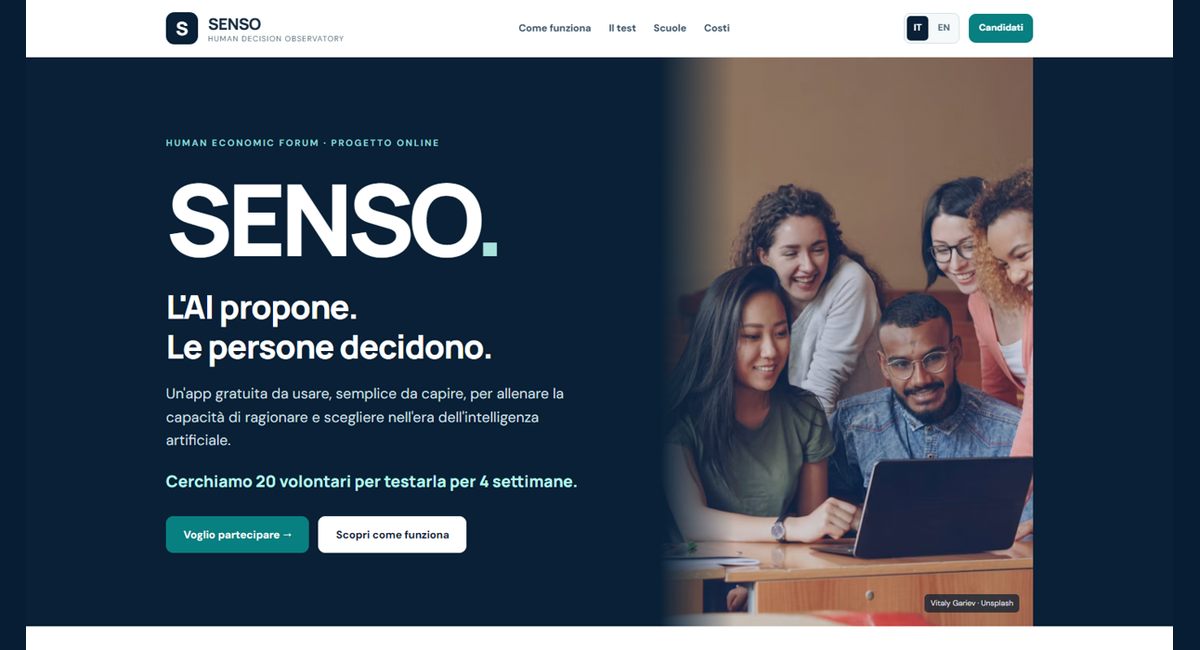
SENSO investigates independent human judgement: participants first see an AI suggestion, then formulate their own answer; other participants' answers become visible only afterwards.
Explore SENSOSENSO: learning to question a persuasive answer
That is why I regard critical thinking as an educational priority, from primary school through university and professional life. Teaching people to operate AI systems is not enough. They must learn to interrogate their answers, challenge them and compare them with credible alternatives.
Tomorrow's universities may look very different, yet the ability to argue, doubt and accept responsibility will matter even more. SENSO — What Would You Do? was conceived to train this independence.
Participants consider a real problem and see an AI-generated suggestion before writing their own response. That sequence makes it possible to study how recommendations influence human judgement. They can read other participants' answers only after submitting their own.
The purpose is not to glorify opposition to AI. It is to make the act of choosing visible. The same discipline belongs in boardrooms. When an algorithm proposes an investment, restructuring or strategic choice, directors must be able to demonstrate that they considered alternatives, assumptions, unintended consequences and grounds for disagreement.
San Marino: from a small trial to an international idea
In this context, ongoing dialogue with counterparts in the Republic of San Marino to explore a possible HEF collaboration on preventive governance and critical-thinking education has a particular significance.
The idea includes an international centre or laboratory and an initial SENSO pilot with a limited group of volunteers, followed by possible engagement with schools, universities, businesses and professionals. To be precise, this remains a project under development, not an institutional agreement already signed.
Scientific collaboration with universities can help assess whether participants improve their ability to spot errors, distinguish facts from interpretations and defend independent decisions in the face of seemingly authoritative automated recommendations. San Marino could serve as a starting laboratory for a model that other countries might adapt.
The real political programme for 2027
Before hearing another pledge of public spending, I would like to hear political leaders answer a different set of questions. Which services have become irreplaceable? Who controls their continuity? How long could we manage without them? Who pays for the costs of dependence? And how will we teach younger generations not to delegate their critical conscience?
A programme equal to our time should demand more replaceable and interoperable infrastructure, independent assessment of systemic risks, genuine continuity plans, preventive financing of collective safeguards and education that allows people to think with machines without being ruled by them.
Meaningful Capitalism begins here: we should judge an economy not only by its output but also by the real freedom it leaves people and the responsibility it assumes towards the collective systems from which it profits. The Systemic Social Dividend seeks to express that responsibility economically. SENSO seeks to safeguard the human capacity to recognise and exercise it.
Read the full DSS proposal — 16 pages
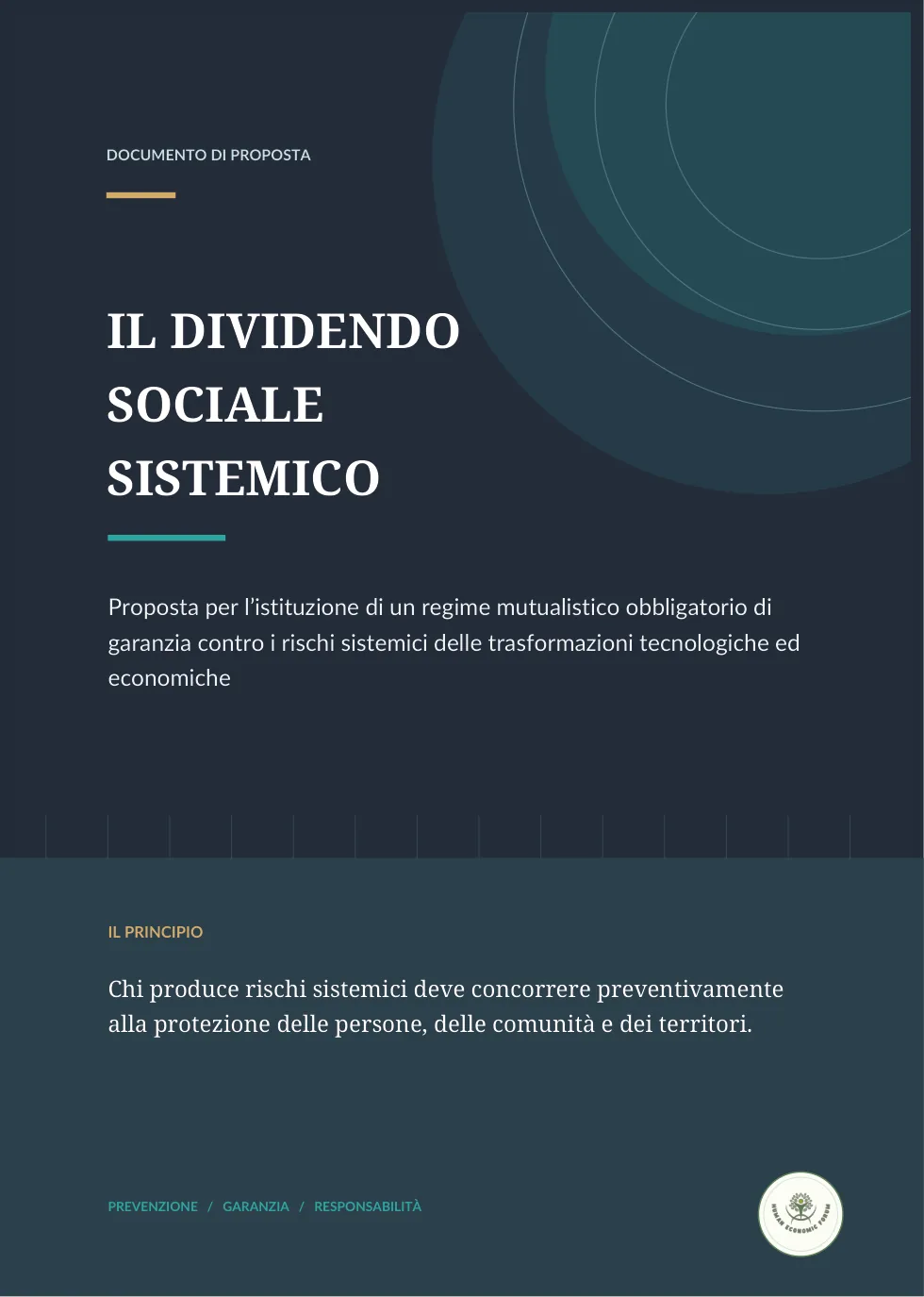
Explore the 16-page Systemic Social Dividend proposal, its rationale, objectives and model of preventive economic responsibility. The framework remains open to scientific and legal scrutiny.
The future I fear is not just surveillance capitalism. It is technological neo-feudalism, in which a few actors control the material and cognitive conditions of existence while everyone else, formally free, grows accustomed to having no real choice.
This outcome is not inevitable. To prevent it, we must move beyond asking how much money to distribute and ask whom we depend on, why, and on what terms.
I do not want a society of human beings domesticated by the convenience of their dependencies. I want a society able to choose.
Sources and references
DSS: frequently asked questions
Is it a citizens' income?
No: it addresses systemic dependence and risk rather than household income support.
Is it a wealth tax?
No: its proposed basis is systemic risk, not personal wealth.
Is it law?
No: it requires research, legal design and validated indicators.
Join HEF 2026 — 9 December
9 December 2026 · Sala della Regina, Chamber of Deputies, Rome. A day of discussion on AI, robotics, responsibility and the Systemic Social Dividend. Explore the programme and request accreditation, subject to confirmation.
ProgrammeRequest accreditation#DividendoSocialeSistemico #DipendenzaSistemica #CapitalismoDelSenso #SystemicSocialDividend #HumanEconomicForum #SENSO #GovernanceAI
- European Commission — Italy Economic Forecast
- Cisco ThousandEyes — AWS Outage Analysis, 20 October 2025
- European Banking Authority — DORA
- European Commission — NIS2
- European Commission — Digital Markets Act
- European Commission — Data Act
- Microsoft Research / Carnegie Mellon — Critical Thinking Study, 2025